Tree Roots and Sewer Lines in Atlanta — What Every Homeowner Must Know
Published March 8, 2026
Metro Atlanta, GA
Atlanta is often called the “City in a Forest” for good reason — the metro area has one of the highest urban tree canopy coverages of any major American city. That green beauty has a hidden cost for homeowners: tree roots are the single leading cause of sewer line blockages and failures across Cobb, Fulton, DeKalb, and Gwinnett counties. Understanding how roots invade sewer lines, which trees are the biggest culprits, and what can be done about it is essential knowledge for any Atlanta homeowner.
Why Tree Roots Target Sewer Lines
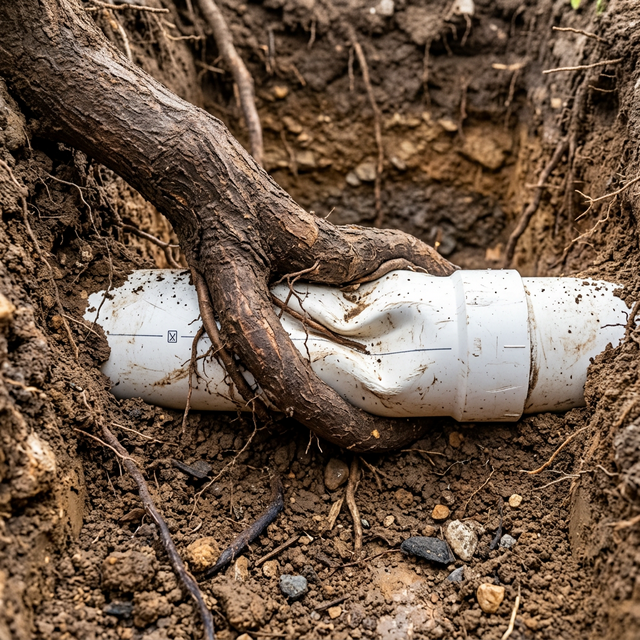
Tree roots grow toward three things: oxygen, moisture, and nutrients. Your underground sewer line provides all three. Even deep underground, sewer pipes emit warmth and a small amount of moisture vapor through microscopic pores in the pipe material or tiny gaps at pipe joints. Root systems — which can extend far beyond the tree’s visible canopy in any direction — detect this vapor and grow toward it.
Once a root tip encounters even a hairline crack in a pipe joint or a slightly offset connection, it enters the pipe. Once inside, the root encounters warm, nutrient-rich wastewater — ideal growing conditions. Within months, a single root intrusion can branch into a dense mass that fills the pipe, dramatically slowing flow and eventually causing complete blockages.
Atlanta’s Most Aggressive Tree Root Offenders
Not all trees pose equal risk. Species with shallow, wide-spreading, or particularly aggressive root systems are the most common culprits in Metro Atlanta sewer line damage:
- Silver Maple (Acer saccharinum): Perhaps the most destructive tree for underground infrastructure in Atlanta. Silver maples produce extraordinarily fast-growing, wide-spreading, and aggressive root systems. They are extremely common in Sandy Springs, Dunwoody, and intown Atlanta neighborhoods.
- Willow (Salix spp.): Willows have evolved specifically to seek out moisture. Their roots are famous for traveling very long distances toward water sources — including sewer lines, water mains, and drainage pipes.
- Sweetgum (Liquidambar styraciflua): Georgia’s native sweetgum produces surface roots and deeper laterals that can easily span 60+ feet. Very prevalent throughout Metro Atlanta’s suburban tree canopy.
- Oak (Quercus spp.): Oak roots are dense and powerful. While generally slow-growing compared to maples, they generate enormous mechanical force once established inside a pipe, and their roots can split or crush older clay sewer pipes.
- River Birch (Betula nigra): Common near the Chattahoochee River and its tributaries running through Cobb, Cherokee, and North Fulton counties. Birches are highly water-seeking and are frequently found in sewer lines near creek corridors.
How Root Damage Progresses Over Time
Root damage to a sewer line is not an overnight event. It progresses gradually in predictable stages:
- Stage 1 — Entry (Years 1–3): Fine root tips enter through a joint gap or hairline crack. No symptoms yet. Detectable only by camera inspection.
- Stage 2 — Growth (Years 3–7): Root mass increases inside the pipe. Drainage begins slowing very slightly. Still functional but roots are now collecting grease and debris.
- Stage 3 — Partial Blockage (Years 5–10): The root mass now restricts flow noticeably. Slow drains appear, toilets gurgle, minor backups begin occurring during heavy household water use.
- Stage 4 — Complete Blockage or Pipe Collapse (Years 10+): The root mass completely blocks the pipe, or its mechanical force has cracked and collapsed the pipe. A full sewage backup into the home is now imminent or has already occurred.
Root Removal Methods and Their Limitations
Mechanical Root Cutting (Drain Snake with Cutting Blades)
The most common immediate solution. A powered drain snake equipped with specialized rotary cutter heads is run through the sewer line to slice through the root mass. This clears blockages and restores flow quickly, but critically — it does not remove the root or kill it. Within 6–18 months, the roots regrow back to their original density.
Hydro-Jetting
High-pressure water jetting (3,000–4,000 PSI) can remove root masses and simultaneously scour scale and grease from the pipe walls. It is generally more effective than cutting alone for clearing built-up debris, but similarly does not kill the root or repair the breach through which it entered.
Copper Sulfate Root Treatments
Copper sulfate crystals or foaming treatments flushed into the sewer line can kill root tips on contact and inhibit regrowth for a period of time. However, they are most effective as a preventive or early-stage treatment and are restricted in some jurisdictions because copper sulfate can harm the bacteria in septic systems and municipal treatment plants. They are generally ineffective against an established, heavy root intrusion.
Pipe Lining (CIPP — Cured-in-Place Pipe Lining)
For a pipe that root damage has cracked or weakened, trenchless pipe lining is a method offered by some Atlanta plumbing contractors. A resin-saturated liner is inserted into the damaged pipe and inflated, pressing against the walls. When cured (via UV light or steam), it creates a smooth, seamless new pipe inside the old one — sealing all cracks and joints through which future roots could enter. However, A&G Plumbing does not perform pipe lining. While minimally invasive, CIPP lining is dependent on the structural integrity of the existing pipe. If the pipe is severely bellied, offset, or partially collapsed, a liner cannot restore the proper grade needed for reliable long-term drainage.
Pipe Bursting & Open-Cut Replacement — A&G’s Approach
In cases where the sewer pipe has completely collapsed or is too corroded and bellied to support a liner, physical replacement is the only lasting solution. Pipe bursting is a trenchless option used by some contractors — it pulls a new pipe through the path of the old one while breaking the old pipe outward. At A&G Plumbing, we specialize in traditional open-trench excavation and full sewer line replacement. While this requires digging, we believe it is the most reliable, long-lasting method — particularly for Metro Atlanta’s older sewer lines. When a line is severely bellied or crushed by roots, open-trench replacement allows our team to properly grade and bed a brand-new pipe from scratch, ensuring correct slope and eliminating the bellied sections that would otherwise continue to collect waste and cause repeat blockages. No patch or liner can replicate the performance of a perfectly graded, brand-new PVC line installed by experienced excavation crews.
Preventive Tips for Atlanta Homeowners
- Know the location of your sewer line before planting trees. Keep large-root tree species at least 20–30 feet away from the pipe’s path.
- Choose sewer-safe tree species for landscaping near your drain field — crape myrtles, dogwoods, and ornamental grasses have minimal root aggression.
- Have a sewer camera inspection performed every 3–5 years if you have large, mature trees on your property.
- If you buy an older Atlanta home with mature oaks, sweetgums, or silver maples on the property, a sewer camera inspection before closing is a strongly recommended contingency item.